
The Roadmap to Operational AI
How to move from experimentation to real value
Most organisations we speak to are already experimenting with AI.
They have piloted tools. They have tested use cases. In some cases, they have even deployed Copilot or built early agents.
But very few would say that AI is truly operational across their business.
That gap matters.
AI only becomes valuable when it is embedded into the way the organisation works. Not as an isolated capability, but as part of day to day workflows, decision making, and service delivery. What we see in the market is that the difference between experimentation and value is not technology. It is how organisations approach the journey and how they are prepared to transform themselves to leverage the value of AI.


AI success is not about tools
There is still a tendency to treat AI as something that can be introduced through a deployment project.
That approach does not work.
AI does not behave like a traditional system rollout. It is not a platform that you configure once and then scale automatically. It changes how people work. It surfaces weaknesses in data and process. It requires decisions about governance, risk and ownership that many organisations have not needed to make before.
The organisations seeing real value are those that recognise this early. They focus less on the tool and more on what needs to be in place around it.
The six pillars of AI enablement
To move from experimentation to operational AI, there are a number of foundations that need to be in place. We typically describe these as six pillars of enablement:
AI Capability
Data
Systems architecture
Operating model
Process
People and culture
These are all underpinned by Security and Data Protection.
Each of these matters. None can be ignored.
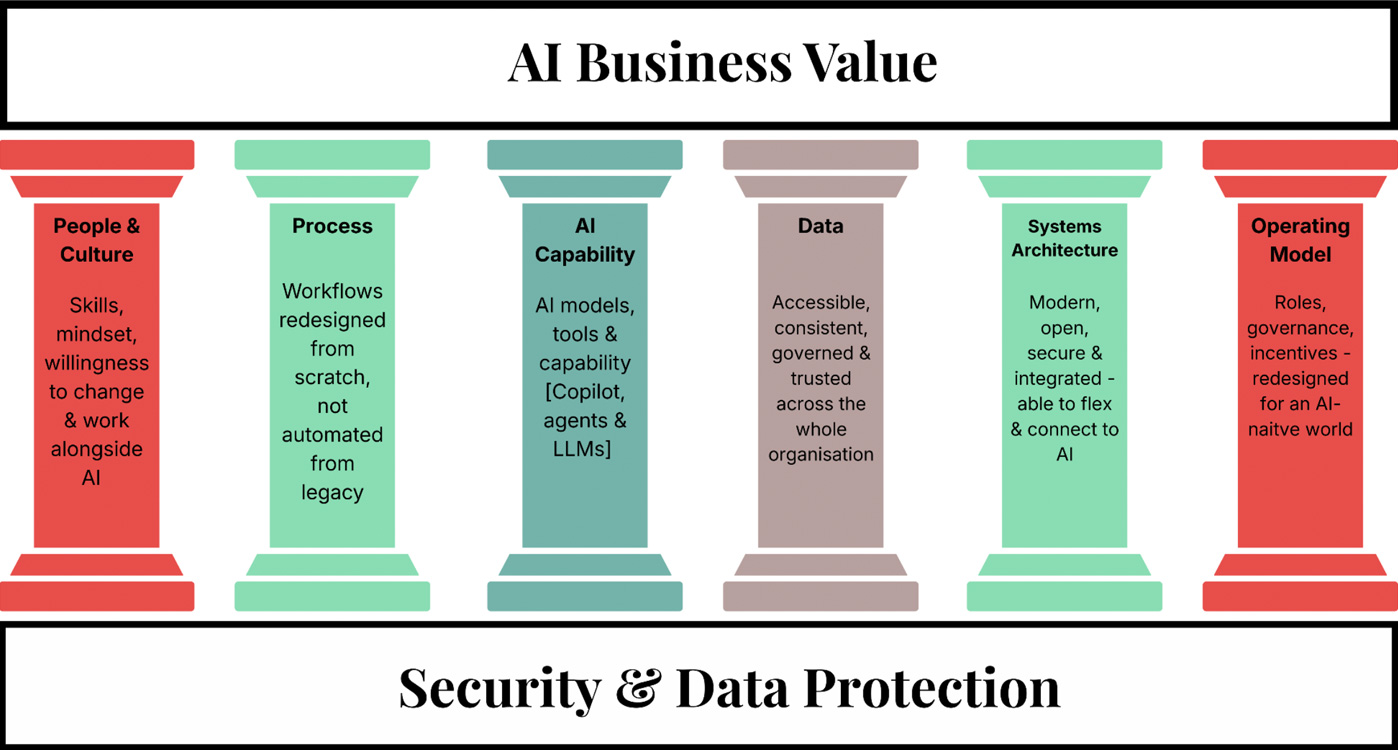
Strong data without the right operating model leads to isolated success that cannot scale. A defined architecture without cultural adoption leads to underused capability. Training without workflow change leads to short term engagement that quickly drops away.
The point is simple. AI value is created through alignment across these areas, not optimisation of any one of them.
What organisational readiness really looks like
There is a lot of discussion around AI readiness, but it is often misunderstood.
Readiness is not about whether you can technically deploy a tool. Most organisations can.
Real readiness is about whether you can deliver and sustain change.
It means having clarity on where AI fits within your business strategy. It means understanding the risks and how they will be managed. It means knowing who owns outcomes, not just who owns the technology. It means having the data structures, governance, and processes in place to support the way AI will actually be used.
Without this, adoption stalls or fragments.
With it, organisations can move quickly and with confidence.
From isolated use cases to scalable value
One of the biggest challenges is deciding where to start.
Many organisations begin with a long list of ideas. Some of these generate value. Many do not scale. The risk is that effort becomes fragmented and momentum is lost.
A better approach is to identify opportunities that sit at the intersection of three things:
- Clear business value (ideally linked to key business KPIs)
- Repeatability
- Alignment to existing or future workflows
This is where we see the strongest outcomes, particularly as organisations begin to think about agents and more complex automation scenarios.

Agents are accelerating the opportunity
The emergence of AI agents is making this challenge even more important.
Agents have the potential to automate complex workflows, coordinate tasks across systems, and act as digital workers alongside human teams. But deploying agents successfully requires far more than the technology itself.
Organisations need clear governance, trusted data, well-defined processes, and an operating model that supports new ways of working. Without these foundations, even the most sophisticated agent will struggle to deliver meaningful value.
This is why the conversation is shifting from AI adoption to AI enablement.
The organisations creating the greatest value from AI are not necessarily those with access to the most advanced tools. They are the organisations that have built the capability, culture, processes, and governance needed to operationalise AI at scale.
The journey from experimentation to operational AI
AI is already creating a competitive advantage.
The question is no longer whether AI can deliver value. The question is how quickly organisations can build the foundations required to realise that value consistently across the business.
At First AI, we help organisations navigate that journey.
From discovery and readiness assessments through to AI strategy, workflow redesign, agent development, automation, governance, and capability building, we work alongside our clients to turn AI potential into operational reality.
Because successful AI transformation isn't about deploying a tool.
It's about transforming how work gets done.
Schedule an AI Strategy Call
Whether you're exploring Microsoft Copilot, evaluating AI agents, redesigning workflows, or building an AI roadmap, First AI can help you identify opportunities, build capability, and scale AI with confidence.
Book a discovery call with our team to discuss your AI enablement strategy and roadmap.
Build capability. Unlock value. Scale AI.